

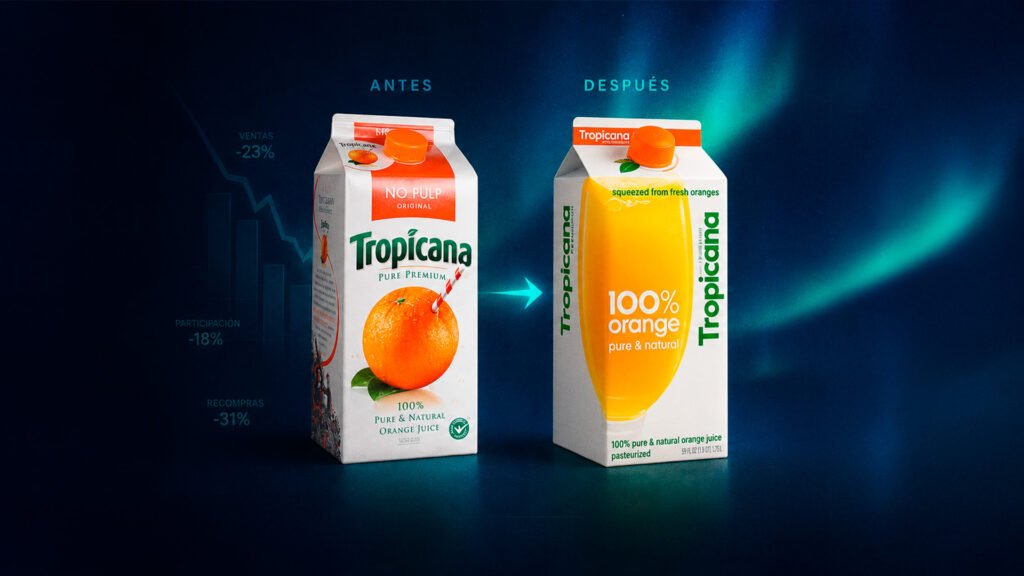
In January 2009, Tropicana rolled out a complete packaging redesign for its Tropicana Pure Premium in North America. The investment in the redesign was estimated at USD 35 million[1]. In under two months, unit sales dropped 20% and revenue fell 19%, translating into an estimated direct loss of USD 30 million for the brand[2]. By late February, the company announced it was bringing back the original packaging. The total cost of the experiment — redesign, advertising, recall, and the sales decline — topped USD 50 million[1].
The consumer study that would have caught the problem before launch would have cost a fraction of that figure.
A mistake that comes at a high price: cutting corners on market research
When a company decides to skip market research, it isn’t saving money. It’s betting against its own consumers.
According to Nielsen data widely cited across the industry, roughly 85% of new consumer packaged goods in the US are no longer on shelves two years after launch[3]. The reasons are rarely about quality or ad spend. What fails is the assumption behind the decision: someone assumed something about the market that was never verified.
In Chile, this plays out every day. Brands that launch products assuming “people will get it,” campaigns that assume “the message is clear,” repositionings that assume “customers will stick with us.” The key word is assuming. Assuming is the most expensive way to make business decisions.
Three areas where skipping research ends up costing more
1. Product launches without behavioral validation
A classic case is Cheetos Lip Balm, launched by Frito-Lay in 2005: a Cheetos-flavored lip balm that was pulled from shelves shortly after[4]. A single concept study with consumers would have been enough to predict that people wanted to eat Cheetos, not smear them on their lips.
A concept study usually costs a fraction of what a mid-sized launch costs, once you add up development, packaging, initial production, media spend, and an eventual recall. The typical ratio is that the cost of not researching ends up being 5 to 20 times the cost of the study that was skipped.
2. Brand repositionings without prior listening
When Gap redesigned its logo in October 2010, the backlash on social media was so immediate that the brand reverted to the previous logo six days after launch[5]. The whole operation was estimated at USD 100 million in total cost between development, communications, and the reversal[6]. A prior social intelligence study would have detected the strong emotional attachment to the original logo — and would have flagged that the redesign was breaking that bond instead of strengthening it.
3. Communication campaigns without pre-testing
A campaign whose message doesn’t resonate with the audience isn’t just a campaign that fails to convert: it’s burned media budget. If a brand invests a significant media budget and the creative was never tested, the risk is losing that investment without finding out until the final report. A behavioral pretest using landing pages and ads — what at Maggiore we call our Iterative Experimentation Platform — costs a fraction of the ad spend and can multiply ROAS by two or three simply by choosing the right message.
The invisible cost: the decisions you never made
There’s an even costlier price, and a harder one to see: the opportunities lost from not understanding the market. A company that doesn’t research fails to spot the emerging segment, misses the consumer frustration that a competitor did catch, and never realizes that the ingredient already sitting in its catalog is exactly what the category is looking for.
Consumer insights aren’t an expense: they’re an early-detection system. Brands that invest in social listening, market research, and competitive intelligence pick up on weak signals before their competitors do, move at the right moment, and gain a significant edge.
The false economy of “we already know what they want”
There’s a phrase that comes up in almost every meeting where the decision is made to skip research: “we already know what customers want.” Sometimes it’s the founder who says it. Sometimes the commercial manager. Sometimes the marketing team.
The problem is that thinking you know isn’t the same as having verified it. What the founder believes is true is what was true when they created the product five years ago. What the sales team believes is true is what they hear from customers who already bought — not from the ones who went to a competitor. What the marketing team believes is true is what they saw in the last campaign, not what’s happening with the next cohort of consumers.
The difference between “knowing” and “having measured” is exactly the difference between Tropicana in January 2009 and Tropicana in March, after the recall.
How to change the equation
The good news is that modern market research is faster, cheaper, and more actionable than it was ten years ago. Today you don’t need a six-month quantitative study to validate a decision: with social listening we can map public conversation in days, with iterative experiments we can test concepts on real landing pages in weeks, and with review and search analysis we can identify barriers and motivators without contacting a single consumer through a traditional survey.
The question for any business owner or Head of Marketing isn’t whether they can afford the research. It’s whether they can afford the decision they’re about to make without it.
Bread today, hunger tomorrow. The study you skipped today is the loss you’ll be explaining to the board next quarter. My honest recommendation: think twice before “cutting” this expense.
Sources
[1] The Branding Journal — “What to learn from Tropicana’s packaging redesign failure?”
[2] Neurensics — “How Tropicana lost $30 million due to new packaging”
[3] Beverage Industry — “Nielsen: 85 percent of new products fail in the marketplace”
[4] 24/7 Wall St. — “50 Worst Product Flops of All Time”
[5] Marketing Made Clear — “Gap’s 2010 Logo Redesign: Timeline, Backlash, and Aftermath”
[6] Avanza Branding Agency — “Gap’s Logo Redesign Disaster: A $100M Lesson”