

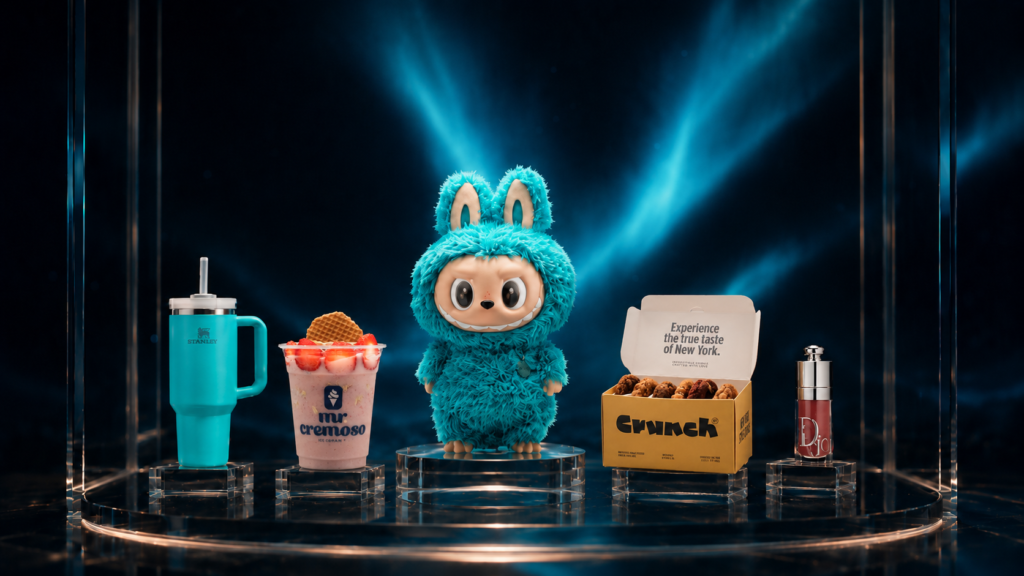
In August 2025, a rare Labubu edition (a 17-centimeter plastic plush toy with a monstrous face) sold on eBay for USD 10,500. It was a Pop Mart x Vans collaboration whose original price was USD 85, representing a markup of more than 100 times[1]. A life-size human version of the character was auctioned for USD 150,000[2]. Pop Mart, the Chinese company that owns the IP (intellectual property), saw its stock price multiply more than tenfold between early 2024 and mid-2025, rising from HKD 16 to over HKD 200[3].
Meanwhile, in Chile, housing costs have been rising faster than incomes for more than a decade, and the OECD ranks the country among the markets with the worst price-to-income ratio evolution since 2010[4]. The share of young people who believe they will buy a home before turning 35 falls year after year.
How do these two things connect? Welcome to the era of small luxury.
What is small luxury (and why it’s the most important consumer trend of the decade)
The concept of “small luxury” or “little luxury” describes a pattern where the customer, unable or unwilling to buy the big traditional symbols of success (a house, a car, an international trip), redirects that desire toward small, accessible, highly visible objects that fulfill the same emotional function: marking identity, treating oneself, feeling like you’re making progress.
This is known as the lipstick effect, a concept popularized by Leonard Lauder, chairman of Estée Lauder, who observed after the September 11, 2001 attacks that lipstick sales rose 11% in the last quarter of the year, echoing a 25% rise in cosmetics sales during the Great Depression[5]. The idea is simple: when big spending gets restricted, small indulgences spike.
And the most interesting data point from 2024 is that this dynamic is reshaping the entire luxury market. According to the annual Bain–Altagamma 2024 report, the global personal luxury goods market fell around 2% in 2024, its first non-Covid downturn since the Great Recession, losing about 50 million consumers over two years[6]. People didn’t stop aspiring to luxury. They just changed where they redirect that desire: toward objects that are more accessible, more visible, and more shareable.
The four cases that define the trend
Stanley Quencher: the tumbler that goes viral twice a year
Stanley has been selling tumblers to campers and workers since 1913. Its annual revenue was USD 73 million in 2019. After a blogger made the 40-ounce Quencher model go viral, sales exploded: USD 194 million in 2021, USD 402 million in 2022, around USD 750 million in 2023, and more than USD 800 million in 2024[7]. In other words, revenue multiplied more than tenfold in five years thanks to a single product that costs between USD 35 and USD 50.
Labubu: the Hermès of millennials
Pop Mart, the Chinese company behind the IP, posted a revenue explosion of 106.9% in 2024, reaching RMB 13,038 million (USD 1,810 million). The Labubu IP specifically grew 726% year-over-year, going from RMB 370 million in 2023 to RMB 3,040 million in 2024[8]. Lisa from Blackpink, Rihanna, and David Beckham have all been photographed with the plush toy hanging from USD 5,000 handbags. The strategy is real scarcity, blind boxes, limited editions, announced drops, the mechanics of traditional luxury, applied to an object whose base price is around USD 30.
Hailey Bieber Smoothie: USD 19 with a line down the street
The Erewhon supermarket in Los Angeles has sold a smoothie designed with Hailey Bieber for USD 19 since 2022, eventually adding it to its permanent menu[9]. The formula is simple: a celebrity, a visually recognizable ritual, and a price that justifies posting it on Instagram. Half the value of the product is the ability to show it off.
Crumbl Cookies: USD 1.2 billion in cookies
Crumbl Cookies built an empire of more than 1,000 stores and estimated sales of USD 1.2 billion in 2024, offering six new flavors every week, available for only seven days[10]. The product is the cookie. What’s actually being sold is the FOMO of missing out on the flavor of the week. The franchise, however, has already felt the model’s fatigue: sales per location fell significantly between 2022 and 2023 once the novelty stopped being news[11].
Why this is happening (and why it matters for your brand)
The classic explanation — “people are broke and settling for less” — doesn’t capture what’s really going on. The truth is more interesting: small luxury fulfills three psychological functions that traditional luxury used to fulfill, and nothing else is replacing them.
- Visible identity. The small object is seen. A Stanley on your desk says something. A Labubu hanging from a backpack says something. The house you didn’t buy is invisible.
- Frequent reward. Instead of one big purchase every five years, these are weekly micro-rewards. The dopamine hit of buying gets triggered more often.
- Tribal belonging. Every object belongs to a community. The “Stanley moms“, the Labubu collectors, the Erewhon regulars. Buying the object is buying the membership.
What this means for brands
If your brand sells products priced between USD 20 and USD 200, you’re in the hottest segment of the market right now. But careful: it’s not enough to lower the price or “premiumize” the packaging. The brands capitalizing on this trend are doing three things well:
- They build real scarcity, not manufactured scarcity (drops, limited editions, designs that sell out).
- They turn the object into content (the unboxing, the collection, the ritual are part of the product).
- They build community before the product (the collectors exist before the collectible).
The Crumbl case also serves as a warning: when novelty becomes the only reason to come back, fatigue sets in. Small luxury built solely on manufactured scarcity wears itself out.
For Chilean and Latin American brands, the opportunity is still wide open. Most of the local market still treats these products as “premium mass consumption,” when in reality they are accessible identity objects — and that requires a different marketing strategy, a different type of content, and a different type of community.
The question for any brand today isn’t whether it can enter small luxury. It’s whether it’s willing to treat its small product with the same sophistication traditional luxury applied to its own.
Because the consumer certainly is. They gave up on the house, but they chose the plush toy with care.
Sources
[1] Kursiv Media — “Limited-Edition Labubu Resells for $10,500 on eBay”
[2] Antique Trader — “From a Blind Box to Big Bucks as a Human-Sized Labubu Figure Sells for $150K”
[3] EBC Financial Group — “Pop Mart Stock: What’s Fueling Its 600% Rise?”
[4] OECD — Affordable Housing Database
[5] Wikipedia — “Lipstick effect”
[6] Bain & Company — “Luxury Stumbles in 2024 but Can Still Return to Solid Growth”
[7] CNBC — “How a 40-ounce cup turned Stanley into a $750 million a year business”
[8] Visual Capitalist — “Visualized: Pop Mart’s Labubu Revenue Surge”
[9] Erewhon — Product page: Strawberry Glaze Skin Smoothie
[10] CNBC — “Crumbl Cookies: From ‘fun side hustle’ to bringing in $1 billion a year”
[11] Restaurant Business Online — “Fast-growing Crumbl’s unit volumes and store profitability took a hit last year”