

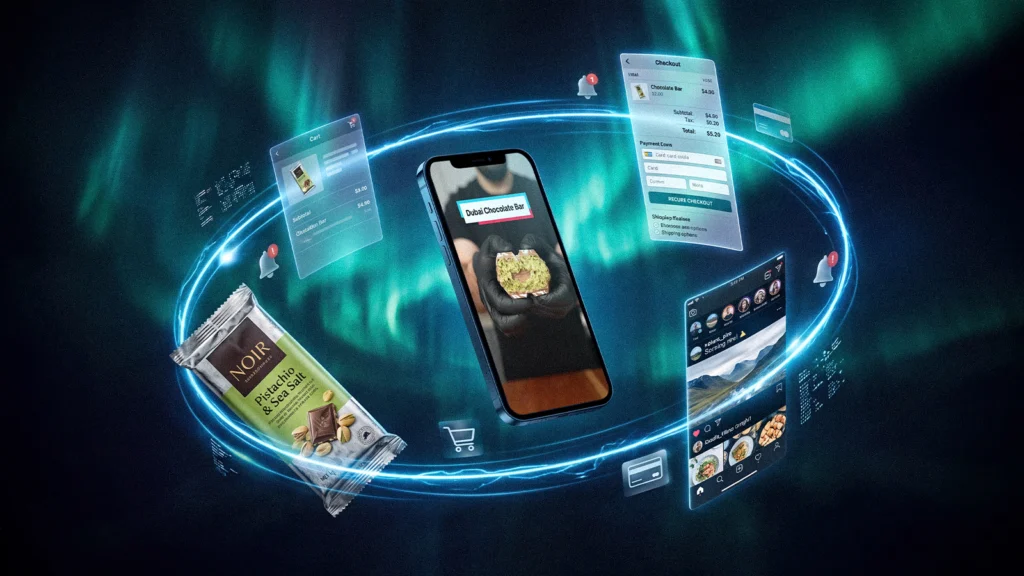
In December 2023, an influencer posted a 30-second TikTok video showing herself breaking open a chocolate bar filled with pistachio paste and crispy kataifi dough. The video surpassed 124 million views. In the months that followed, global demand for pistachios rose so sharply that the price of the nut jumped 34% year-over-year, California’s harvests came under strain, and countries like Iran exported 40% more of the ingredient in just six months.
All that, because of a 30-second video.
The life cycle of a consumer trend in the TikTok era doesn’t last months — it lasts days. And understanding how that cycle works is becoming one of the most valuable skills in digital marketing.
TikTok is no longer just entertainment: it’s the new search engine
The shift in search habits is one of the most relevant data points of recent years for marketing. In 2022, Google itself acknowledged that nearly 40% of young people preferred TikTok or Instagram to search for, say, where to eat. [4] Since then, the trend has only grown.
According to Adobe Express’s 2026 report, 49% of U.S. consumers have already used TikTok as a search engine — an 8-percentage-point increase compared to 2024. [5] And according to WARC, 86% of Generation Z users search on TikTok weekly, a figure very close to the 90% who do so on the leading traditional search engine. [6]
But there’s an important nuance here: using TikTok to search doesn’t mean abandoning Google. What’s emerging is a multi-layered search behavior, where people discover on TikTok, dig deeper on other channels, and decide on the marketplace. The consumer journey is no longer linear — it’s a loop across platforms.
The full cycle: from the FYP to the cart
The life cycle of a consumer trend on TikTok follows a fairly consistent pattern, one that the Dubai chocolate case illustrates perfectly:
Phase 1 — The video. Authentic content, with a strong sensory or emotional component, appears in the FYP of thousands of users simultaneously. In the case of Dubai chocolate, it was the ASMR of the crunch that made it irresistible. The algorithm did the rest. [1]
Phase 2 — Mass curiosity. The video generates millions of searches for the product. People want to know what it is, where to get it, and how much it costs. In this phase, the original product sells out and the first imitations start appearing.
Phase 3 — Category expansion. The ingredient or format breaks free from the original product and starts showing up in everything: milkshakes, croissants, mooncakes in Asia, dulce de leche in Argentina, alfajores in Uruguay. But there’s something deeper happening in this phase: the viral moment doesn’t just shift existing demand — it creates an entirely new category where nothing existed before. Artisanal chocolate shops that had never worked with pistachio suddenly had a star product in their display case. Entrepreneurs who didn’t exist as a brand launched their own versions and found their niche. In this sense, going viral isn’t just a consumption phenomenon — it’s a business enabler. [3] Each version generates its own content cycle.
Phase 4 — The impact on supply chains. When a trend gets big enough, it stops being a digital phenomenon and becomes a real market problem. Pistachio supply in California fell 20% in a year, global prices rose 34%, and producers around the world adjusted their crops. [1]
In less than 18 months, a 30-second video traveled through every one of those phases.
The new consumer: discovers on TikTok, trusts communities
Another key data point from the Adobe 2026 report: 65% of Generation Z uses TikTok to search — but only 25% finds it effective for finding information. [5] That 40-point gap between use and satisfaction says something important: TikTok doesn’t replace traditional search engines, it complements them in a very specific role — that of sparking desire.
After discovering something on TikTok, people go to Reddit to look for honest reviews, to YouTube to watch tutorials, and to Google to compare prices. Reddit already ranks second as the most useful search platform according to consumers, at 29%, ahead of ChatGPT (26%) and YouTube (24%). [4]
For brands, this means it’s no longer enough to show up on a single channel. The new purchase decision cycle demands presence and consistency across multiple touchpoints: discovery on TikTok, validation in communities, conversion on the marketplace.
What viral trends teach marketing
The Dubai chocolate cycle, Brazil’s morango do amor, and movie theater popcorn buckets all have something in common: none of them were the result of a traditional marketing campaign. All of them were born from authentic content that the algorithm amplified.
That doesn’t mean brands can’t prepare. On the contrary: understanding the phases of the cycle allows for timely reaction. Appearing in Phase 1 is nearly impossible — but being ready for Phase 2 and 3 is a strategic decision. Brands that already had pistachio in their catalog when Dubai chocolate exploded capitalized on it without having planned anything. Those that had to reformulate took months to catch up.
The TikTok cycle has also democratized who can set a trend: it’s no longer just big brands or traditional media. A video from an artisanal chocolate shop in Dubai altered the global nut market. A neighborhood candy shop in Brazil created two-hour lines.
Riding a trend isn’t luck: it’s attention. The brands and entrepreneurs who capitalize on viral moments are the ones who monitor weak signals before they explode, have the agility to react quickly, and don’t wait until the trend is at its peak to move — because by then, it’s usually already too late.
Sources
[1] Xataka — TikTok sparked the viral craze for Dubai chocolate, and it’s rattling the global pistachio market — https://www.xataka.com/magnet/tiktok-desato-fiebre-viral-chocolate-dubai-eso-esta-rompiendo-mercado-mundial-pistacho
[2] La Verdad Noticias — Dubai chocolate triggers global crisis: pistachio shortage in Mexico — https://laverdadnoticias.com/economia/chocolate-de-dubai-desata-crisis-global-por-que-hay-escasez-de-pistachos-y-precios-por-las-nubes-en-mexico-20250505
[3] Canal 26 — Dubai sets a global trend: pistachio chocolate wins over palates in Argentina — https://www.canal26.com/general/2025/11/25/dubai-impone-tendencia-mundial-el-chocolate-con-pistacho-conquista-paladares-y-reinventa-el-dulce-de-leche/
[4] Search Engine Journal — Gen Z Preference For TikTok Over Google Drops 50%, Data Shows — https://www.searchenginejournal.com/gen-z-preference-for-tiktok-over-google-drops-50-data-shows/568267/
[5] Adobe Express — TikTok as a search engine: How consumers and businesses use it — https://www.adobe.com/express/learn/blog/using-tiktok-as-a-search-engine
[6] WARC / Mediaweek — Gen Z turns to TikTok for search almost as often as Google — https://www.mediaweek.com.au/warc-gen-z-turns-to-tiktok-for-search-almost-as-often-as-google/
[7] Her Campus / Search Engine Land — Survey: 51% of Gen Z women prefer TikTok, not Google, for search — https://searchengineland.com/gen-z-tiktok-google-search-survey-431345
[8] Shopify — 18 TikTok trends to watch in 2025 — https://www.shopify.com/es/blog/tendencias-de-tiktok