

The world is going through a moment of rising geopolitical tension. New conflicts are emerging, alliances are being redefined, and strategic decisions are being made behind closed doors.
When we think about these events, we tend to focus on their consequences: market volatility, changes in energy prices, supply chain disruptions, or impacts on international trade.
But there’s another signal, much subtler, that can appear even before the news reaches the headlines: consumer behavior.
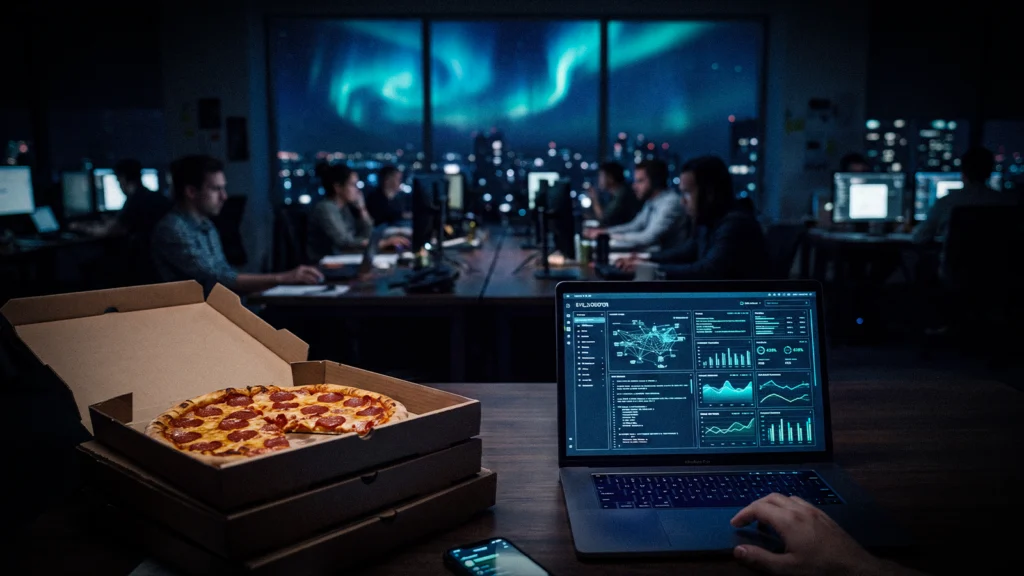
A fascinating example of this is what’s known as the “Pentagon Pizza Index“. The logic is simple. When critical decisions or moments of high political or military activity are anticipated in the United States, government officials and analysts tend to work late into the night at places like the Pentagon, the White House, and other federal agencies in Washington DC. And when that happens, something curious happens nearby: pizza orders go up.
Over time, some observers began to notice a pattern: sharp spikes in pizza orders at restaurants near centers of power seemed to coincide with moments of intense political or military activity.
What started as a curiosity ended up becoming a small cultural phenomenon on the internet. Today there are even accounts that monitor activity at pizzerias near government buildings as an informal signal that something important might be happening behind the scenes. Check out Pizzint: https://www.pizzint.watch/
Beyond the anecdote, this case illustrates something highly relevant for those of us who work analyzing data and consumer behavior: consumption doesn’t just react to events, it often anticipates them.
Seemingly trivial patterns like food orders, online searches, urban mobility, or shopping trends can reveal changes in human behavior before they translate into public decisions or visible economic impacts.
Observing consumption closely is, in many cases, a way of reading the social context in real time. Of course, a pizza doesn’t explain world geopolitics, but it does remind us of something fundamental: behind every historic decision there are people working, making decisions under pressure… and probably ordering something for dinner late at night.
For those of us who work in market research and behavior analysis, signals like this reinforce a key idea: consumption isn’t just a consequence of the world’s changes. It can also be one of its earliest indicators, which is why keeping a close eye on these patterns doesn’t just help us understand what’s happening today — it can also give us clues about what’s yet to come.