

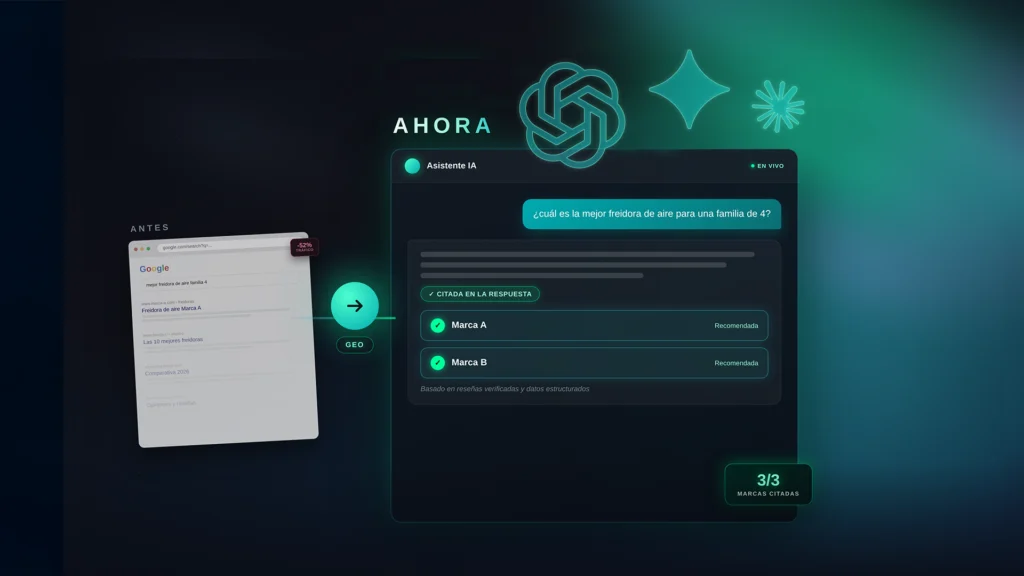
Two years ago, finding the best air fryer meant opening Google, typing a few keywords, and clicking through ten different tabs before making up your mind. Today, more and more people do something else: they ask ChatGPT, “What’s the best air fryer for a family of four?” and get a ready-made answer with two or three recommended brands. No tabs. No scrolling. No clicks.
And here’s the detail that should keep a lot of marketing teams up at night: if your brand isn’t one of those two or three, it effectively doesn’t exist for that user—even if you’re the number-one result on Google.
Search isn’t just “searching” anymore
The first thing that changed is the action itself. We no longer type five keywords and pick from ten blue links; we ask a machine a full question and get a synthesized answer back. Gartner projected that traditional search volume would drop 25% by 2026, and that brands’ organic traffic could fall by 50% or more as people shift to AI-powered search[1].
This is the well-known “zero-click” phenomenon: the answer appears at the top, fully formed, and the user never visits your website. The metric that used to matter most—the click—is disappearing, and it’s taking with it a large share of the traffic many brands used to take for granted.
Ranking is no longer the same as being cited
Here’s the real wake-up call. For years, the logic was simple: rank first on Google and you’re visible everywhere. That equation no longer holds.
An Ahrefs analysis of millions of citations found that the overlap between Google’s top-ranking pages and the sources AI actually cites dropped from 76% to around 38% in a matter of months[2]. Separate research from Brandlight puts that figure even lower: below 20%[3]. In short, ranking number one on Google no longer guarantees that ChatGPT, Gemini, or Perplexity will mention you when someone asks.
That’s where an acronym worth learning comes in: GEO (Generative Engine Optimization). SEO is about optimizing your site to appear in search results; GEO is about optimizing it to appear inside the answer an AI generates. They share technical foundations, but they’re entirely different games.
The trust test almost everyone fails
When we audit brand websites to see how they perform in this new landscape, the same pattern shows up again and again. Google evaluates content using a framework called E-E-A-T—Experience, Expertise, Authoritativeness, and Trustworthiness[4]—and AI engines reward very similar signals.
Most brands do well on the first two (they know their product and have experience) but fall short on the last two. Author bylines are missing, there are no update dates, sources aren’t cited, and third-party validation is weak or nonexistent. The result: they’re losing share of voice in AI-generated answers without realizing it. The AI doesn’t consider them trustworthy enough to include, and no one at the brand is even tracking it.
How to play the GEO game
The good news is that this can be fixed. It’s not magic; it’s method. Here are four concrete steps:
Structured data and complete product attributes. Schema.org markup, ingredient or component lists, clear claims, and use cases. These are the signals AI uses to decide which brand deserves a spot in its answer. Most sites implement only about half of what’s needed.
Strong third-party citations. AI doesn’t just cite your website; it looks at reviews, specialized publications, regulatory bodies, and authoritative forums. The goal isn’t simply to publish more on your own blog—it’s to earn mentions in the places where AI actually gets its information.
Content structured as answers. Pages should be written to answer a consumer’s question, not just to target a keyword. If the prompt is “best X for Y,” the page needs to give a direct answer, structured so an AI can easily pick it up.
Regular, brand-specific AI audits. Define 25 to 40 prompts where your brand should show up. Track your presence (or absence) across ChatGPT, Perplexity, Gemini, and Google’s AI Overviews. Diagnose the gap, close it, and measure again. In this landscape, what isn’t measured quietly fades away.
The new shelf space
For decades, competing for Google’s first page was like fighting for eye-level shelf space at the supermarket—the prime spot where you get seen and chosen. That shelf has moved. Today, the premium spot is being featured right inside an AI’s answer.
SEO isn’t dead; it’s still the foundation everything else is built on. But it’s no longer enough for Google to know you exist. The question has shifted from “Do I show up in search results?” to “Do I show up in the answer?” And today, that’s the only shelf that matters.
Sources
[1] Gartner — “Gartner Predicts Search Engine Volume Will Drop 25% by 2026, Due to AI Chatbots and Other Virtual Agents”
[2] Search Engine Journal / Ahrefs — “Google AI Overview Citations From Top-Ranking Pages Drop Sharply”
[3] 5W Public Relations / Brandlight — “New 5W Research: Overlap Between Top Google Rankings and AI-Cited Sources Has Collapsed From 70% to Under 20%”
[4] Shiwaforce — “25% of Search Traffic Will Disappear by the End of 2026 – Gartner’s Latest Prediction”